
Webster County Deed Types and Meaning
The Webster County Clerk records deeds and other land instruments at the courthouse. But an index entry only scratches the surface. A deed conveys whatever interest the document describes. The entry itself reveals nothing about title problems hiding behind it. Read the actual instrument and its legal description. Check any linked releases or court records before calling it a full ownership history.
| Deed Type | What It Does | Common Use |
|---|---|---|
| Deed | Records a transfer and the land description stated by the parties. | Trace a sale, gift, or other conveyance. |
| Deed of trust | Records a security instrument tied to a loan. | Find a lien and later check for a release. |
| Assignment or release | Changes or clears a recorded interest when filed. | Connect a later filing to an earlier instrument. |
| Trustee report of sale | Reports a foreclosure trustee sale. | Follow a foreclosure with the court case and later deed. |
| Plat or land entry | Shows mapped lots or historical land-entry context. | Compare a deed’s lot, tract, road, or stream references. |
A deed and a deed of trust do different jobs. The first records a conveyance. The second is a security interest placed on record. The Webster indexed portal goes further, listing liens, releases, assignments, affidavits, agreements, cemetery deeds, church trustees, and plats. Search the parcel description as well as party names. A mortgage or lien may not be indexed under a street address at all.
What the Webster County Clerk Index Lists
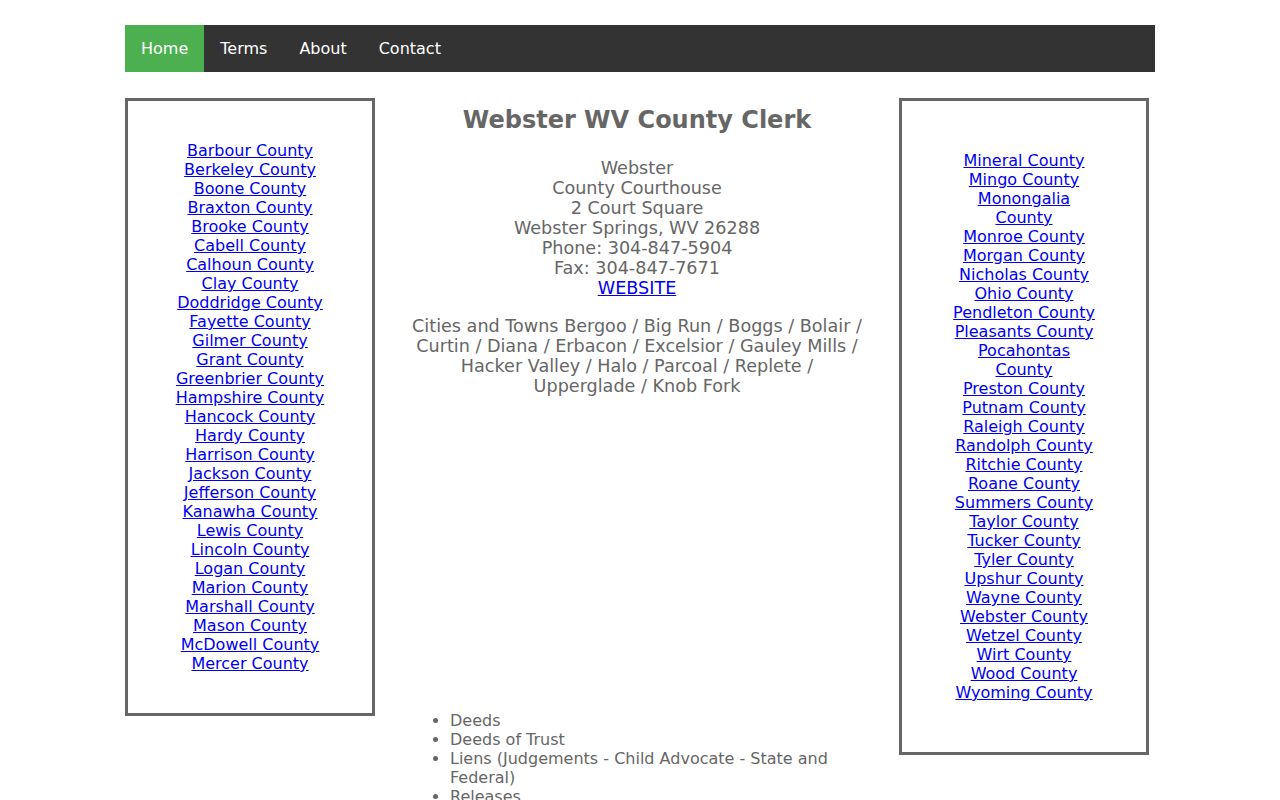
The Webster County indexed land-record portal names the document categories it covers. However, the landing page does not expose a complete live search form or state a date cutover. Its categories include deeds, deeds of trust, judgment and government liens, releases, assignments, agreements, affidavits, plat maps, church trustees, cemetery deeds, and foreclosure trustees' reports of sale. Restricted military discharges are listed as well, so not every category opens a public property-search path. The page publishes no Webster-specific image fee, account rule, result cap, or certified-copy schedule.
Confirm the current access path with the County Clerk. The courthouse office sits at 2 Court Square, Room G1, Webster Springs. Call 304-847-2508 to ask whether a book, image, or certified copy is available.
Treat the portal's category names as a checklist, not a verdict on a parcel. A deed of trust is a security filing. A release may relate to it. An assignment may identify a later holder. A judgment or government lien, though, may need its own release or satisfaction. An affidavit, agreement, or trustee's report adds context without acting as a deed. For each hit, note the document type, parties, date, and instrument reference, then open or request the actual record.
The landing page publishes no guaranteed image range or search syntax. A blank result could reflect a name variation or a different document classification. It could also reflect a year not indexed online, or a scan that the portal does not expose. Search both parties where possible. Test known initials or entity names, and ask the Clerk which older volume or counter lookup fits your deed records question.
The Webster County land-record index is the online entry point for deeds, liens, releases, plats, and other indexed instruments.
The 1888 Fire and Webster County Deed Records
The West Virginia Archives and History finding aid notes that the Webster courthouse burned in 1888. That fact matters when a chain suddenly stops. A missing early book may reflect a preservation gap. It is not proof that a transfer never happened. The surviving index and microfilm runs offer several paths through the later record trail. But they cannot restore every lost instrument.
Keep written notes on the exact grantor and grantee. Note the district wording, date range, and book and page found. If the county index does not bridge the earlier period, search the archive finding aid. Also search the County Clerk's vault and FamilySearch's catalog for Webster County deed material. Nearby county or state records may hold clues. Label any substitute copy as a substitute.
For a pre-fire family or tract search, start from the earliest surviving document you can prove. Then work both forward and backward. A later deed may recite an older conveyance. It may also cite an estate settlement or land description pointing toward a missing volume. Keep that recital separate from the original instrument. It is a clue to another filing, not the lost document itself. Compare names and boundaries with care, because the same surname can belong to unrelated owners.
Trace the Webster County Grantor-Grantee Chain
A grantor conveys the interest; a grantee receives it. To walk a chain backward, begin with the latest deed and identify the grantor. Search that party as an earlier grantee. Repeat with the prior deed until you reach the period you need. Book and page make useful anchors because they point to a recorded volume location, and the archive describes Webster's older deed books and indexes by year rather than by a modern online cutover.
- Start with the current IAS card and copy its owner name, PID, legal description, and deed book/page.
- Find the latest recorded deed and read the parties, execution and recording dates, and full land description.
- Search the grantor as an earlier grantee, including spelling or initial variants shown in the instrument.
- Repeat and log each date, party, document type, and book/page; stop when a gap or an archive period requires in-person research.
- Grantor
- The person or entity named as conveying an interest in the instrument.
- Grantee
- The person or entity named as receiving that interest.
- Chain of title
- The sequence of recorded transfers used to trace ownership over time.
- Book and page
- A volume citation shown on an IAS card or deed reference; verify it against the actual record.
A chain is more than a list of names. A deed may convey only a fractional interest. It may reserve a life estate, name multiple grantees, or describe land later divided among several owners. Match the full legal description and the interest conveyed at every step. If a corporate name changes, compare the entity's filed name and status. If an owner died, look for probate and fiduciary records first. Heirs do not become owners of record automatically.
Webster County Deed Books and Plats on Microfilm
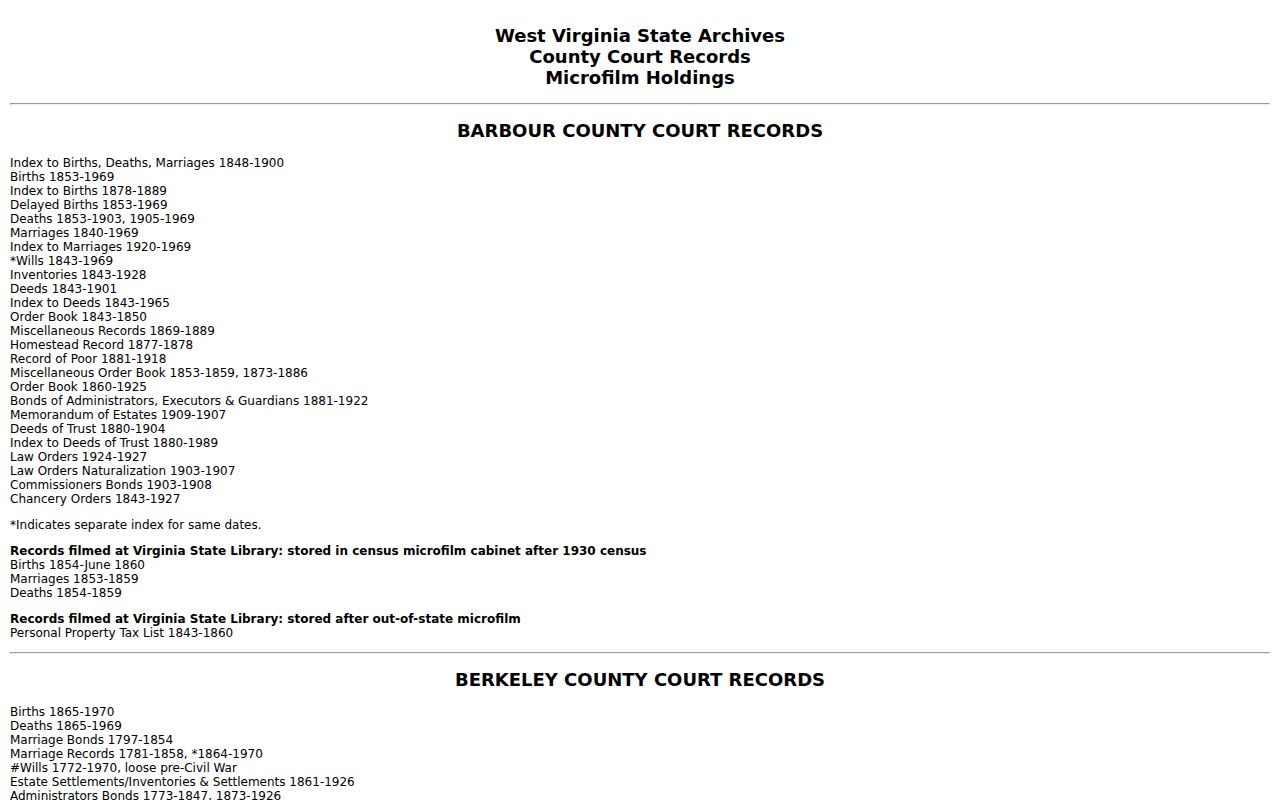
The state archive holds Webster County deed books from 1877 through 1902. A deed index covers 1888 to 1969. The Record of Entries & Plats of Land spans 1860 through 1990, tying early transfers to mapped plats. The West Virginia Archives and History finding aid catalogs every series. It also covers wills, fiduciary records, and court books. Those can explain a transfer outside a sale.
Ordering microfilm takes precision. Give the county, record type, year span, party names, and the district or land description. A modern address may not fit an 1860s entry. Older district labels such as Fork Lick, Glade, Holly, and Hacker Valley should be kept and matched against the parcel's current legal description.
The state archive microfilm finding aid lists Webster deed books, the deed index, and land plats that support a longer chain of title.
Webster County Foreclosure and Land Cases
Deed research in Webster County sometimes collides with a lawsuit. A foreclosure, quiet-title, partition, mechanic's-lien, tax-lien, or estate case can all reshape ownership. The Clerk's index holds foreclosure trustee reports of sale. The Circuit Clerk keeps the litigation record itself. The statewide judiciary reports online circuit records reaching back to 1999; verify the current range at WV Court Record Searches before counting on it.
A docket explains the dispute. It still cannot replace the recorded deed. Federal matters live in PACER. If an older file never surfaces online, Webster Circuit Court at Room G4, 2 Court Square, Webster Springs, 304-847-2421 can explain inspection and copy procedures, and no fee schedule is published.
Request a Webster County Deed Copy
Try the online index first, since many instruments come back with a full image attached. When the page shows only a reference, the scan is missing, or the volume falls before the county put records online, take the request straight to the County Clerk. Have the details ready: parties, document type, recording date, book and page, and a parcel description. Copy and certification fees are not published on the county portal, so ask the office for current amounts. The Clerk sits at 2 Court Square, Room G1, Webster Springs, WV 26288, and answers the phone at 304-847-2508.
A West Virginia FOIA request works as an alternative for a public record you can describe precisely. Name the office, the instrument, the date span, the parcel or address, and the format you want. W. Va. Code §29B-1-3 gives the custodian five days, not counting weekends and legal holidays, to respond, though action can come sooner. The office may bill actual reproduction costs, but no charge for searching or retrieval is permitted. For certified land-record copies, the recording procedure itself is best confirmed with the Clerk.
Bundling several deeds into one inquiry? Keep a plain copy order separate from a title-history project and list every party or citation you know. That precision lets the Clerk tell apart a simple index search, an ordinary copy, and a certified instrument. The county publishes no standard per-page price, no online account rule, and no set turnaround, so confirm each of those with the office instead of borrowing another county’s fee schedule.
Recorded, not guaranteed. An index is evidence of a filing, not a title opinion. Unrecorded claims or missing historical records may exist, so a complete title review belongs with a qualified title professional.