
Read the Webster County Owner of Record Card
The IAS detail card identifies the current owner of record through a labeled field, not a map pin or street address. Read the nearby fields as well. They tie the name to one parcel. They also show whether value sits in the land, the improvements, or the whole assessment.
| Owner(s) | The name or names entered on the assessor’s parcel record. |
|---|---|
| Mailing Address | Where tax notices and other county mail are sent. |
| Physical Address | The location associated with the parcel, separate from correspondence. |
| E-911 Address | Emergency-location text that may be blank or differ from the physical address. |
| PID and District | County, district, map, parcel, and suffix used to identify the account. |
| Deed Book / Page | A recording reference to check with the County Clerk. |
| Tax Year and Sale History | The time context for appraisal and recorded sale entries. |
An owner-of-record field names the party tied to the tax parcel. It says nothing about occupancy. Nor does it identify a property manager. The mailing address serves tax notices. So treat it as a contact clue rather than the situs. Keep both values with the PID. Copy the Owner(s) field exactly, including every name, organization suffix, or estate designation. A tax card reflects one assessment year, while a deed carries its own recording date. Map labels often truncate names for display. For any decision about a conveyance, the deed's grantee and legal description control. A shortened viewer label does not.
Separate Webster County Situs and Mailing Addresses
The physical address tells you where the land sits. The mailing address shows where the mail goes. A Camden-on-Gauley parcel in the sample illustrates the split: a Camden physical address paired with a Webster Springs post-office box for the owner. That distinction is normal. It never moves the parcel into the postal city. Webster Springs itself carries two labels, since legal and census material calls the town Addison while civic and postal material says Webster Springs. If one label fails, try the other. Keep the district and PID either way. Treat the address as a search clue, then confirm the parcel's legal description before drawing conclusions.
The IAS detail card for a Webster County parcel shows the owner field, separate mailing and physical addresses, parcel ID, and deed reference used to check the present roll.
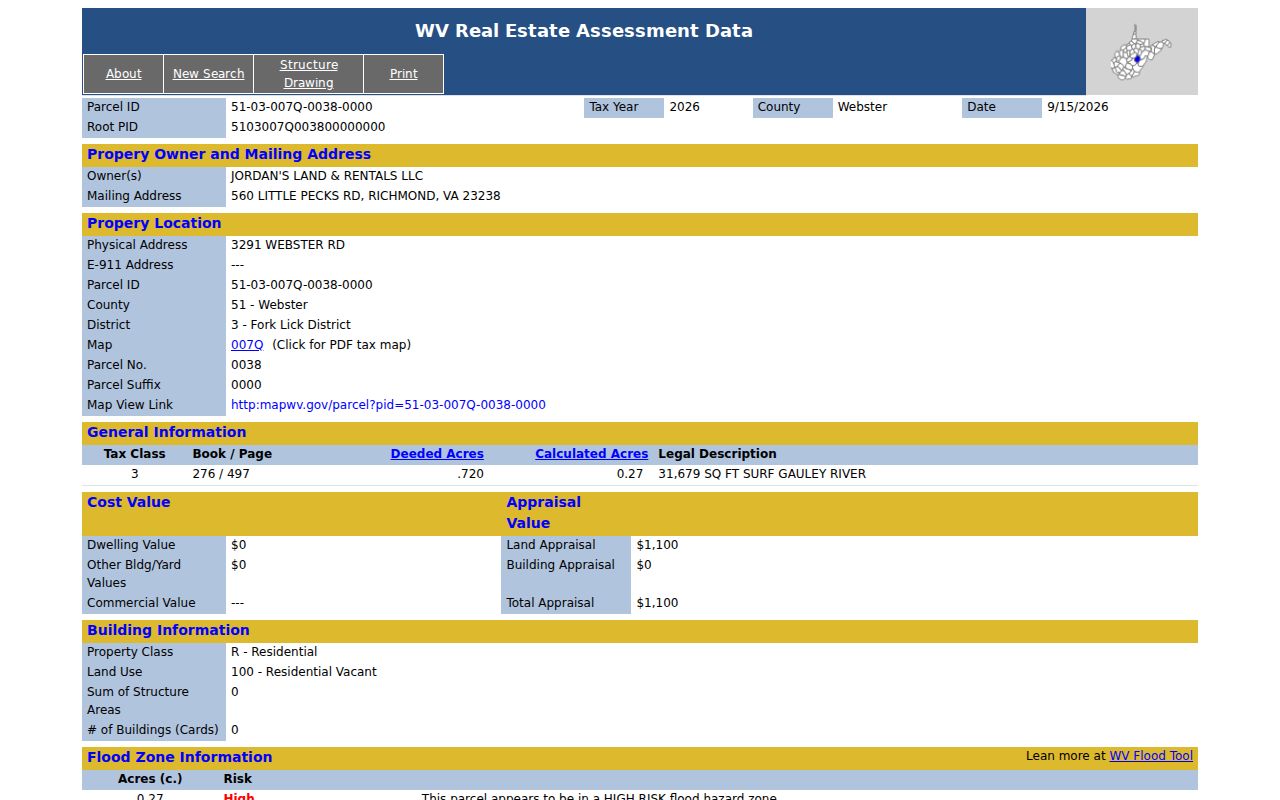
Confirm a Webster County Current Owner
The strongest confirmation in Webster County property records pairs the assessment card with the newest recorded deed. The Assessor's name field locates the account. The Clerk's instrument documents the conveyance itself. If the two sources disagree, check the deed's recording date and the tax year before calling any office.
- Open the Webster County IAS detail and copy `Owner(s)`, PID, mailing address, tax year, and deed book/page.
- Search the County Clerk’s indexed records for the latest deed tied to the parcel or party.
- Compare the deed’s grantee and legal description with the assessment card.
- If the card has not changed, ask the Assessor whether the transfer has reached the next roll update.
- Owner of record
- The name the assessor has tied to the tax parcel for a given roll year.
- Assessment roll
- The assessor’s yearly property record, including parcel and value details.
- Situs and mailing
- The property location and the separate address used for county mail.
- Recording lag
- The time between a deed filing and a later appearance in assessment data.
When the card and the deed agree on the party and describe the same land, you hold a far stronger current-owner check than either document alone. A blank book/page changes the picture. So does a differing deed description. In those cases, search the Clerk index by party name and the parcel's legal description. A transfer can cover one lot. It can even cover a partial interest, so never attach one deed to every property under a similar owner name.
Webster County Current Owner Timing
Webster County's own example states that 2022 taxes reflect what a person owned on July 1, 2021. That anchor matters. It can make the owner on an annual roll differ from the newest grantee in the Clerk's book. W. Va. Code §11-4-8 requires the Clerk to send title-transfer lists to the Assessor by the tenth day of each month. No average update lag is published. Trust the recording date instead. Save the deed's book and page, then check the next assessment year to see the account catch up. A roll difference alone proves nothing. Nor does it mean the seller still holds title. It certainly does not signal a rejected deed. The monthly transfer-list rule sets up an exchange between Clerk and Assessor rather than an online service guarantee. If a card stays unchanged after a recorded conveyance, call the Assessor with the date, instrument reference, and full PID. Ask whether the updated instrument was matched. For tax liability or a payment question, contact the Sheriff separately; that office handles billing and collection.
Entity Names on Webster County Owner Records
The current owner on a Webster County record may be an LLC, a nonprofit, a trust, an estate, or several people at once. Preserve the full name and suffix. A shortened map label can hide the legal form. The West Virginia Business Entity Search can supply an entity type, status, address, creation date, and registered agent for a business filing. A registered agent is a service contact. It is not a substitute owner name. The business record helps identify which organization appears in a deed, but the instrument and legal description remain the ownership evidence. When a person has died, probate or a fiduciary deed may explain the change.
Correct a Webster County Owner Entry
A name on a parcel changes only through paperwork. The Assessor requires a legal document, such as a deed or will, filed with the County Clerk first. Call the Assessor for a misspelling, a wrong address, or a question about your card, and ask what proof they want. A phone call flags an error. It does not transfer ownership.
Here is where to go. The Assessor sits in Room G2 at 2 Court Square, Webster Springs, WV 26288, phone 304-847-2110. The Clerk, in Room G1 of the same courthouse, records instruments at 304-847-2508. Billing and delinquency questions go to the Sheriff in Room G3, 304-847-2006.
For a misspelling, bring a copy of the instrument showing the correct form and ask which card field the Assessor can amend. For a change of ownership, confirm that the Clerk accepted and recorded the deed or other legal document. The Assessor updates the tax entry from filed evidence. A purchase contract, utility account, or mailing-label change never moves title by itself.
Owner name and assessed value answer different questions. West Virginia multiplies appraised value by 60 percent to get assessed value, then applies a levy to set the tax. That math can change the bill without touching ownership. Question the amount? Ask the Sheriff about the account. Question the owner entry? Take the deed or probate document to the Assessor and the Clerk.
Use the Webster County Mailing Address Carefully
Treat the mailing address on the tax record with care. The county keeps it only for tax correspondence. It may be a post-office box or an address outside Webster County entirely. Reading it as the owner's home, workplace, or daily presence is a mistake. The property records will not support that assumption. West Virginia's Address Confidentiality Program does give eligible participants a protected-address option. The county publishes no local implementation details.
Lawful use. Use the record for a purchase, estate, assessment, or boundary matter. Do not use an owner’s name or mailing address to stalk, harass, threaten, or expose anyone.